Days until our Noovo delivery:
Disclaimer: Nothing here is financial advice, and I am certainly not a financial advisor, except to my own kids. To everyone but my kids, do your own math, talk to your own advisor, make your own decisions, trust nothing written here. To my kids, just do exactly what I say.
Now that you’ve watched your million YouTube videos and decided on a camper van, maybe even had the wisdom to choose a Noovo, it’s time to get serious. How are you going to pay for it?
There are two broad possibilities. Pay cash or get a loan. There are innumerable sites about borrowing money, so I won’t go into all the details here. But what I will do is point out a few important things to think about that often seem to be overlooked.
Should you pay cash?
If the answer to the question, are you rich enough to pay $200,000 in cash for a van, is yes, then paying cash is a no-brainer. You give them money, you get a van, you drive away. Easy and clean. You are out adventuring without having to concern yourself with one more bill—and no concern that some future change in your financial picture will force you to sell your van.
However, you still might consider a loan. If you keep that $200,000 in, for example, an index fund, there’s a good chance that your gains will be quite a bit higher than the interest rate on the loan. It’s like a substantial discount on your purchase price.
Consider VOO, a boring Vanguard S&P index fund. Here are its returns from the past ten years.
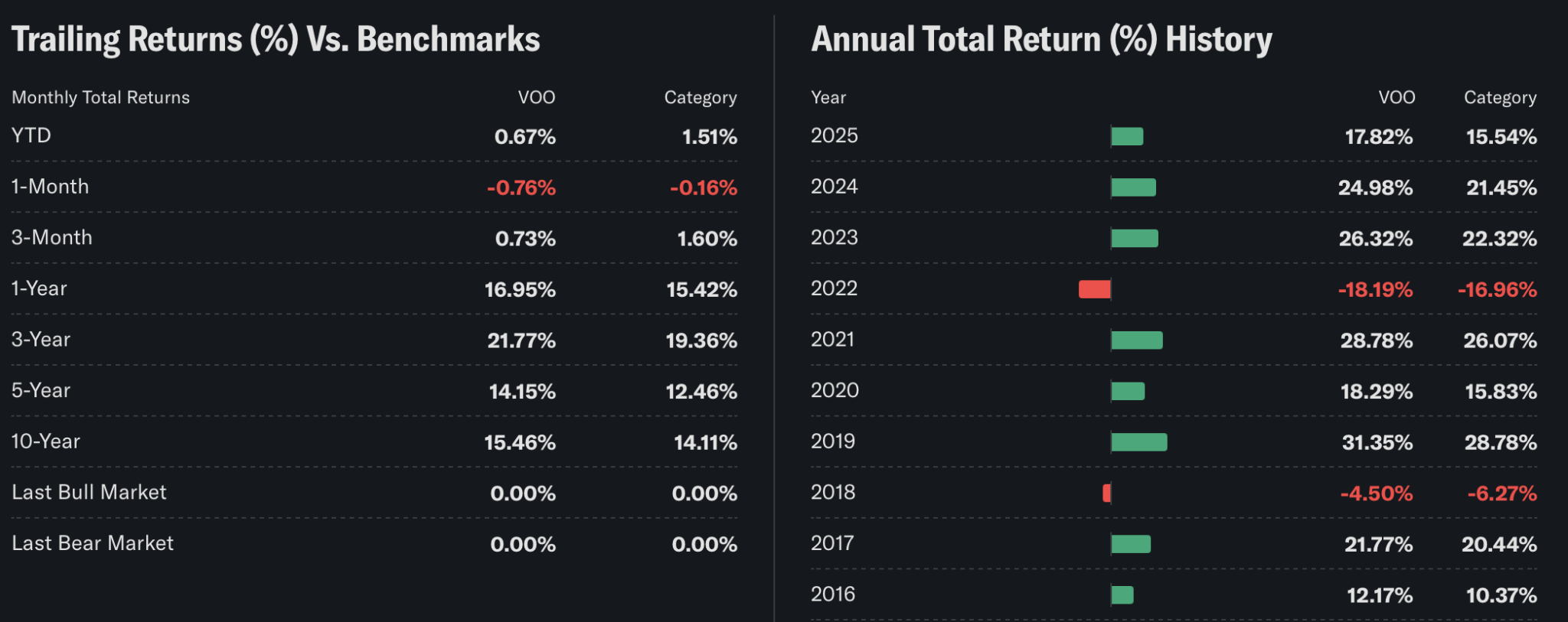
Looking at the right half of the graphic, you can see that there have been up years and down years, but all of the up years have been way, way above the current 7%-ish loan rate for RVs. There have been two down years in that time period, one, in 2022 during the pandemic, was scary bad. Nevertheless, as you can see from the left half of the graphic, the ten-year average return was 15.46%, the five-year was 14.15%, and the three-year was 21.77%. Those returns are far above the loan rate—subtract the loan rate from these numbers, and that is the money that you now have that you would not have had if you paid cash. It can be a lot of money.
But there is risk. There could be a down year as big or bigger than the one in 2022. There could not just be one of those years, there could be a series of those years. Anything below your loan rate is bad, not just negative numbers, so it is worse than it looks.
So the question becomes not are you rich enough to pay $200,000 in cash for a van, but are you rich enough to absorb the additional cost of your van due to your index fund (or wherever you invested the van money) performing poorly? That additional cost is the financial risk you are taking.
Is it a big risk? Is it a small risk? It’s time to read or reread the disclaimer at the top of the page, but this is exactly what we did.
If you can’t pay cash, should you get a loan?
If you are buying a Noovo, they will (as of this writing) suggest two loan companies, RV Lending and Sunshine State RV. You might also try Good Sam and your local credit union. Look on the Noovo forum (or the forum of whatever RV you are buying) and ask for recommendations. If you can’t find such a question asked previously, ask the question fresh. Don’t be afraid to ask what rates and fees people got from the companies and how easy those companies were to work with.
You should shop around and get at least four quotes. When we received our loan quotes, the rates and associated fees were all over the place.
Rate, term, and don’t forget fees
Three important numbers define the cost of a loan: The rate, the term, and the fees.
The rate is what everyone focuses on and what people who got low rates brag about. Currently, the average rates are around 7%, but rates are dependent on the bond market and the bond market moves in mysterious ways. Your credit score, the size of your down payment, and the length of the loan will be the big factors in determining your rate.
The term, the length of time for which you are borrowing the money, is usually 15 or 20 years for an RV, but can be 5 years or other term lengths. Longer terms, of course, will result in lower payments, while the rate, moving in mysterious ways, might be unintuitively higher or lower than you might expect with longer or shorter terms. Your loan officer can see all of these rates. Ask them.
Fees are the great hidden cost of RV loans, and of consumer loans in general. It’s a massive profit center for lenders as borrowers often pay no attention to fees at all, despite the fees usually running into the thousands of dollars. On an RV loan, the fees are usually quoted as a percentage of the loan and run from 6% down to zero, with 2% being common. Two percent of $200,000 is $4000 in fees. That’s a lot of money for pushing paper.

Zero fee loans exist
If you have a good to great credit rating, shop around for a zero fee loan. How are loan companies making money if they aren’t charging you anything for their services? They make it the old-fashioned way. If you are buying through a dealer, the rate the dealer is quoting might be slightly higher than the rate they themselves are getting, and they pocket the difference. Even when working directly with a loan company, your loan is, to the loan company and to other financial firms, an asset that can be bought and sold (and it will be bought and sold). The loan company makes money on that sale—your good credit and high down payment suggest you are a low-risk borrower, and your loan will fetch a premium when it is sold. That’s how they are making their money. That’s not your problem. Your problem is the rate and the fees.
More about fees
To better understand the cost of fees, here’s a simple chart that pretends that the fees are extra interest, so that you can compare loans with various fees and rates, apples to apples. Punching your numbers into Calculator.net’s APR calculator will give you the “effective interest rate” on your loan, which is how you can compare offers. It’s not perfect, but it gets you much closer to the truth.
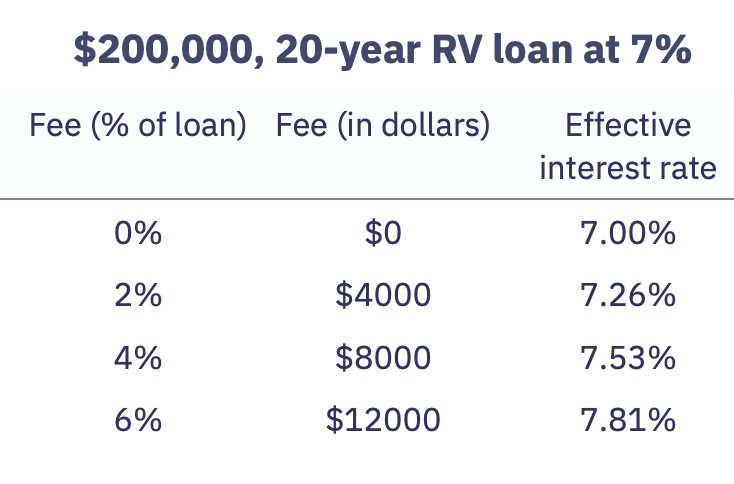
Pay attention to the fees. Any loan officer who gives you a quote without clearly stating the (lucrative) fees is not giving you a honest quote.
The low payment game
Note that nowhere here did I focus on the payment. If you are in the business of selling money (or, more correctly, renting money), it will become quite obvious very quickly that many of your customers care only about the amount of the payment. The lower you can get the payment, the more “affordable” the loan, the better. Nothing else matters. Many years ago, when I was in my early twenties, a friend got a loan for a used car. The dealer was great, everyone was all smiles and helpful, backslapping away like old friends, and they got a great payment. Good times. What is the interest rate on the loan?, I asked. My friend didn’t know. I was incredulous. How can you not know? Then his wife chimed in, pride in her voice: Their rate was 22%.
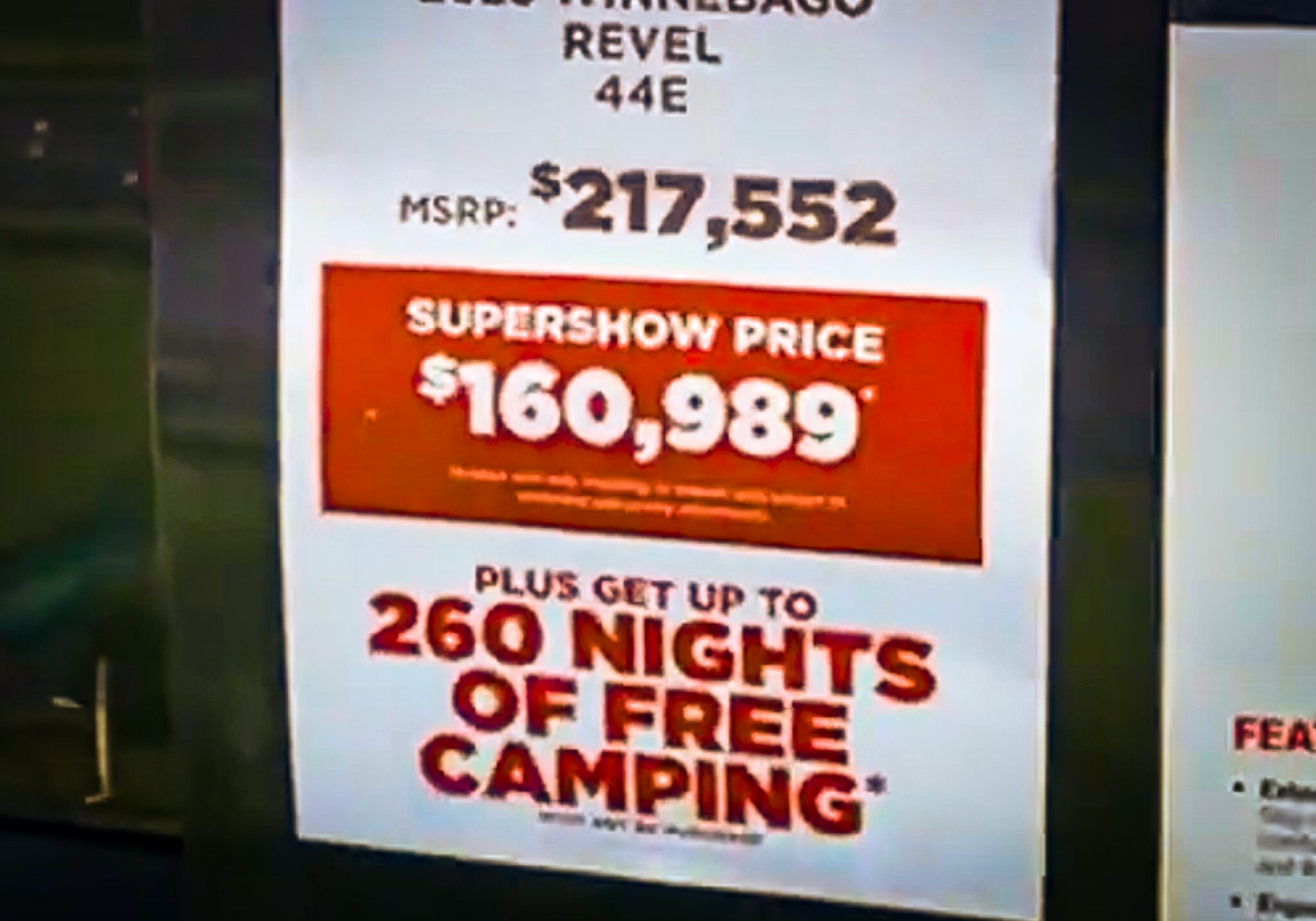
The RV industry lives on people who borrow too much at high rates just to buy an RV that sits in their driveway. In many ways, the RV industry is awful. But there are good people there—we found them and had a great experience financing our van. Understand the basics, get multiple quotes, and keep a level head when dealing with the money side of things. And enjoy your van.