

You probably need to carry a traction board on your van but how should you attach it?. They are sold and carried as pairs, though in practice often one will do, and they need to be mounted somewhere on the van that will allow their ready retrieval if you find yourself stuck in the sand or mud. At the same time, that same mounting location must be a good location to mount muddy and sandy traction boards after they have been used.
One of the most common ways to mount the boards is to use the four-magnet solution offered by Owl Vans. At $200, these imported magnets, which have built-in Maxtrax attachment stems, grip the side of your van, presenting your traction boards to the world like some sort of armor, shielding its owner from an acute masculinity crisis.
At nearly $500 for both the boards and the magnets, you would be right to worry that a thief needs only to grip the boards and pull back to lift them (and the mounts) cleanly off the van.
There are other possibilities. There are suction cups (which would give me nightmares), and there is a combo magnet/JB Weld mount product, and a strap-based system of attaching boards to the tread of your spare tire.
I’m new to vans but not new to road travel. My current vehicle, a 2007 FJ Cruiser, has about 330,000 miles on it, and it has been to 49 states (Hawaii, you are next!). I’ve driven in all kinds of bad weather, including certain high-wind situations that I tend to call “wind events,” due to their bizarre severity. I’ve had Yakima boxes blown open, I’ve had headlights and windshields sandblasted to frost, and I’ve had to hide under overpasses from severe rain (which then turned into supernatural wind tunnels). I will never rely on magnets or suction cups, no matter what their manufacturers say, to attach anything to my vehicle.
One user, on the Noovo Facebook group, had the good idea to drill holes into the side of his rear storage box, mounting the boards in a readily accessible but out-of-the-way manner. My concern with this solution is that the Maxtrax and Bunker boards do not share mounting points— you would, in this case, need to commit to one or the other. And I would worry about leaks from those holes that had to be drilled.
After a great deal of experimentation and walking around Home Depot and Lowes, I came up with a solution that allows my traction boards to be stored in a way that perfectly fits my needs.
What are my needs?
- To mount the boards securely. I mean really securely.
- To be able to mount and unmount the boards easily, since I may be using them to augment my leveling boards.
- Weather and travel durable.
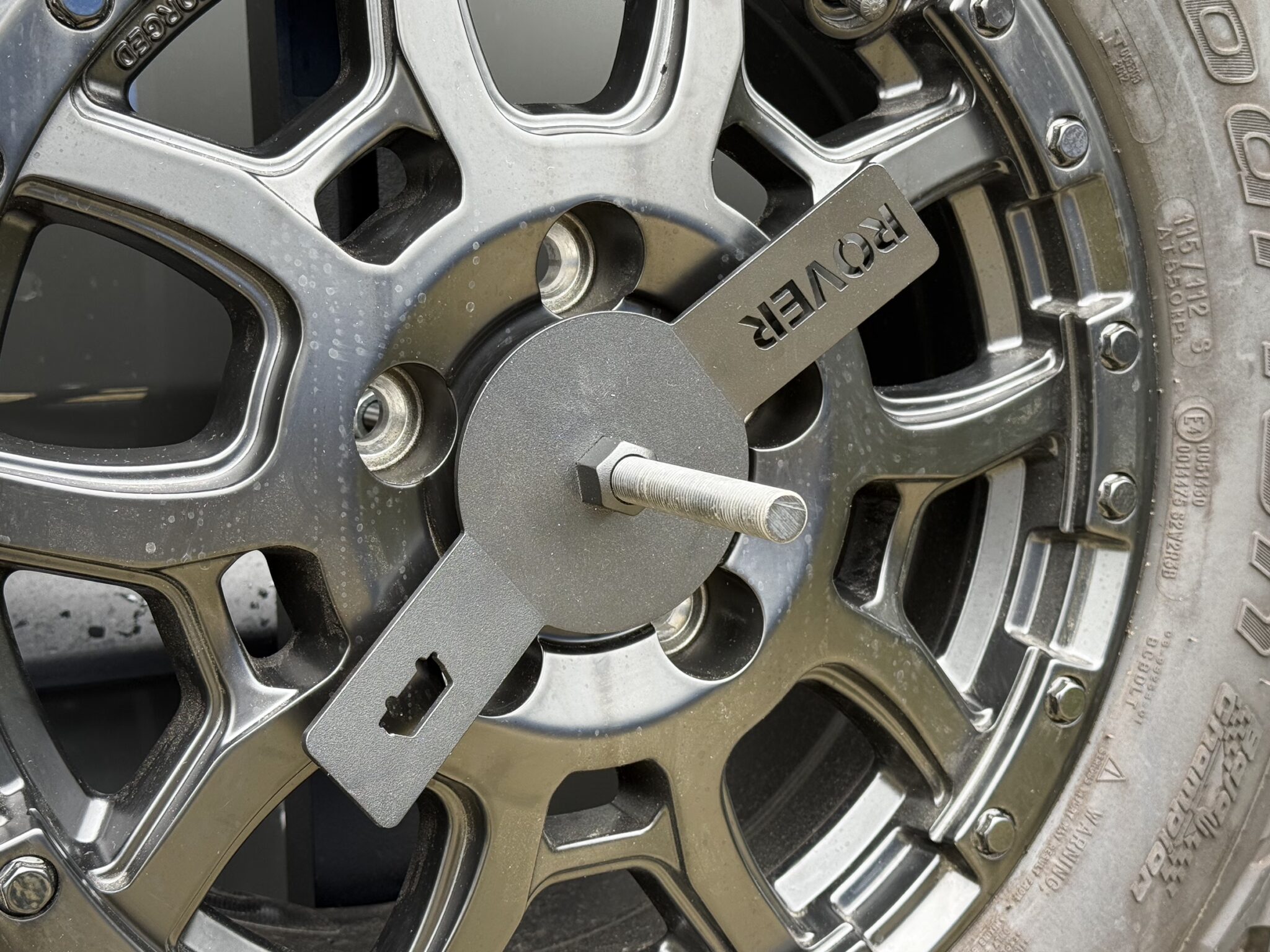
Note, for this to work, you need the full-length screw as it came from Noovo—if the screw has been trimmed shorter, there likely will not be enough left to secure the boards.
For my solution, you will need the following:
• Bunker traction boards in your favorite color. $80.
• A set of “no scratch” cam-buckle straps (often used for surfboards). It comes in four-packs, though you will need only two. $26 for four.
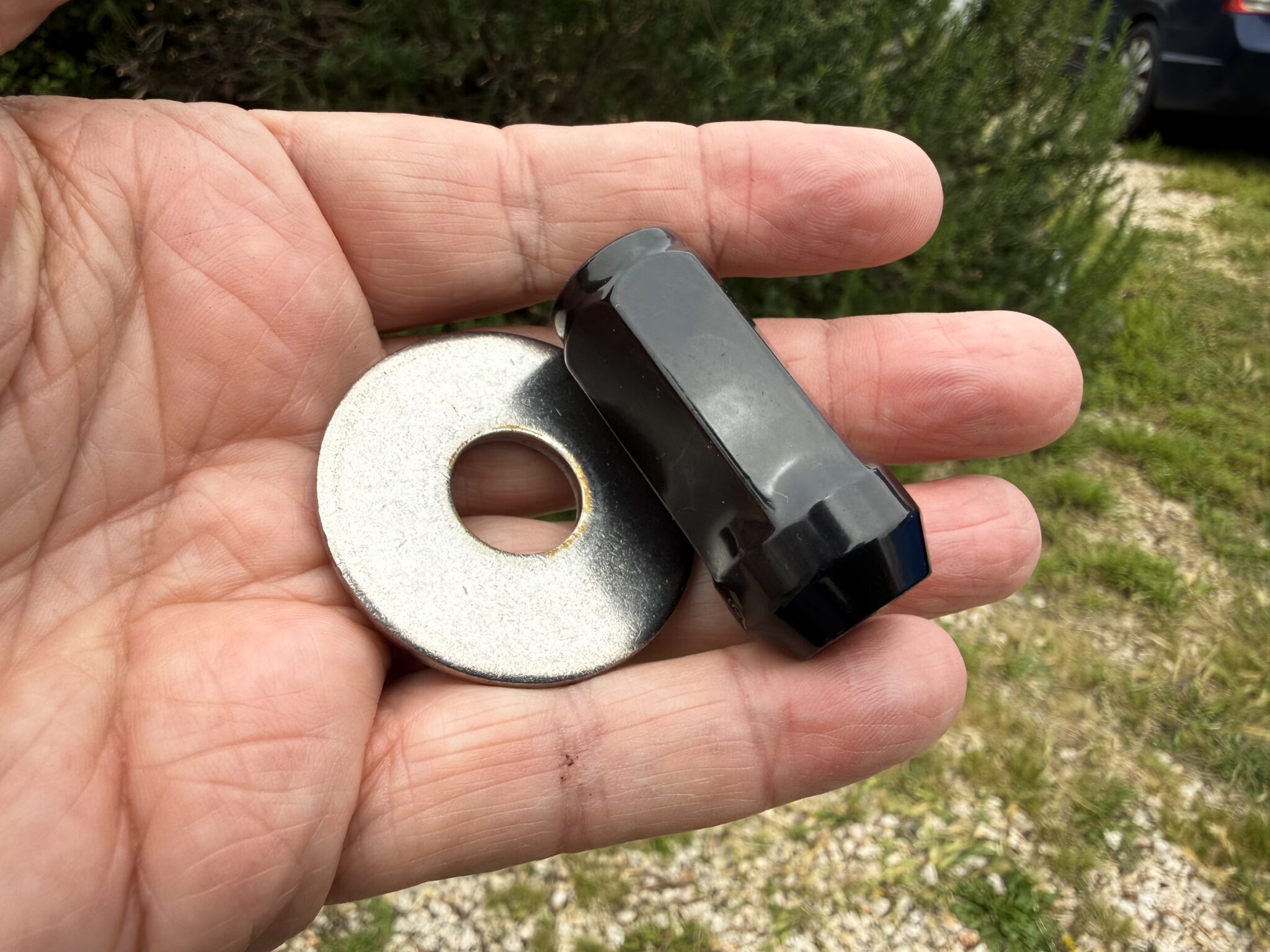
• One stainless steel fender washer, size M14 (14mm, in the Metric section at Ace or order from Amazon, but not available at Home Depot, Lowes, or Tractor Supply). $4.50 at my local Ace or $10 for ten at Amazon.
• An extra-long lug nut, size M14x1.5 (14mm, with a 1.5 pitch. Most M14 nuts, or wing nuts, or M14 anything come in incompatible 2.0 pitch.) You can buy these as a set for $26, leaving you with many extras, or buy a single one on Amazon for $7.50—though I think the ones from the set are slightly higher quality.
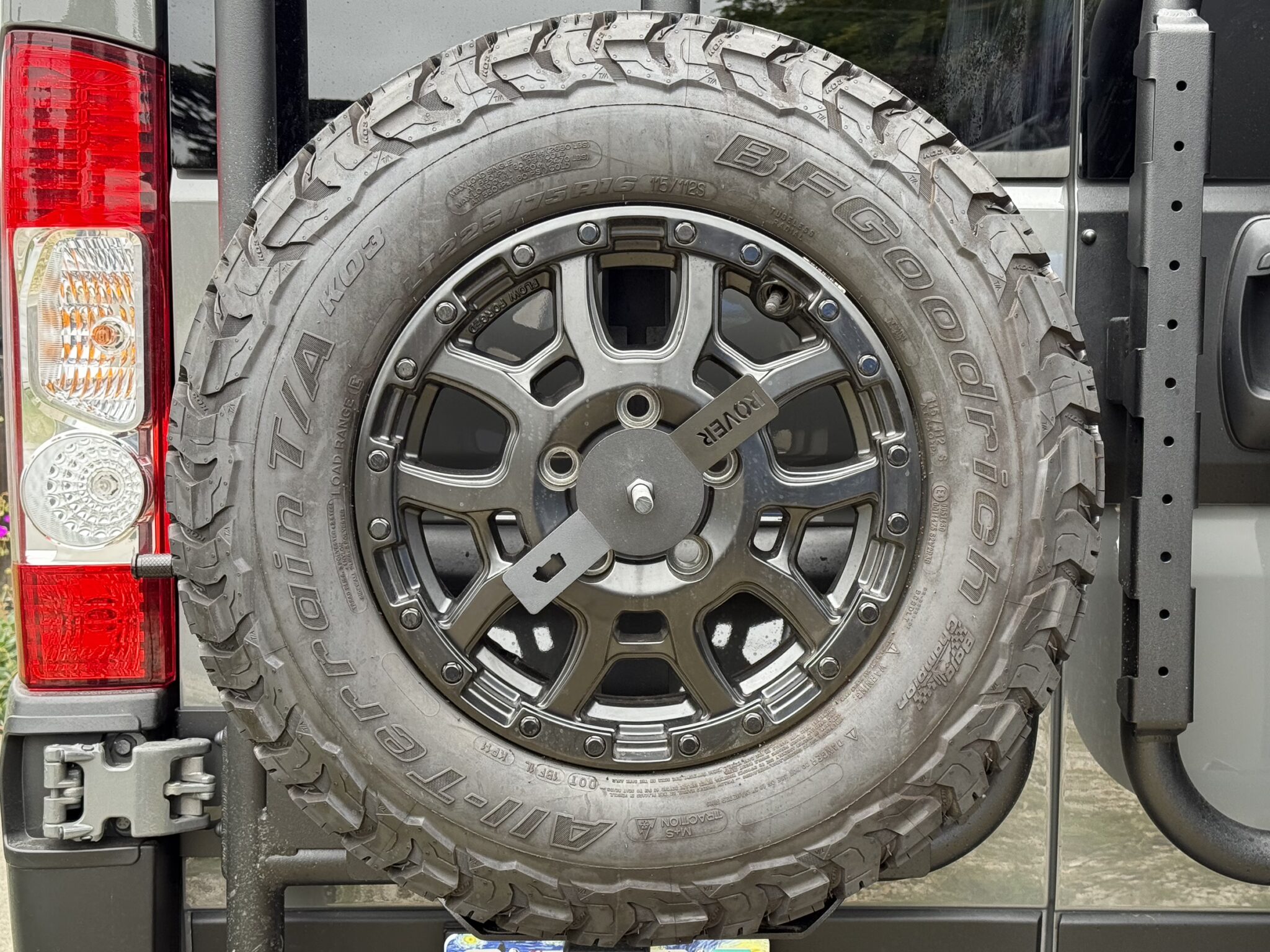
Step 1: Turn the Rover tightener to an angle
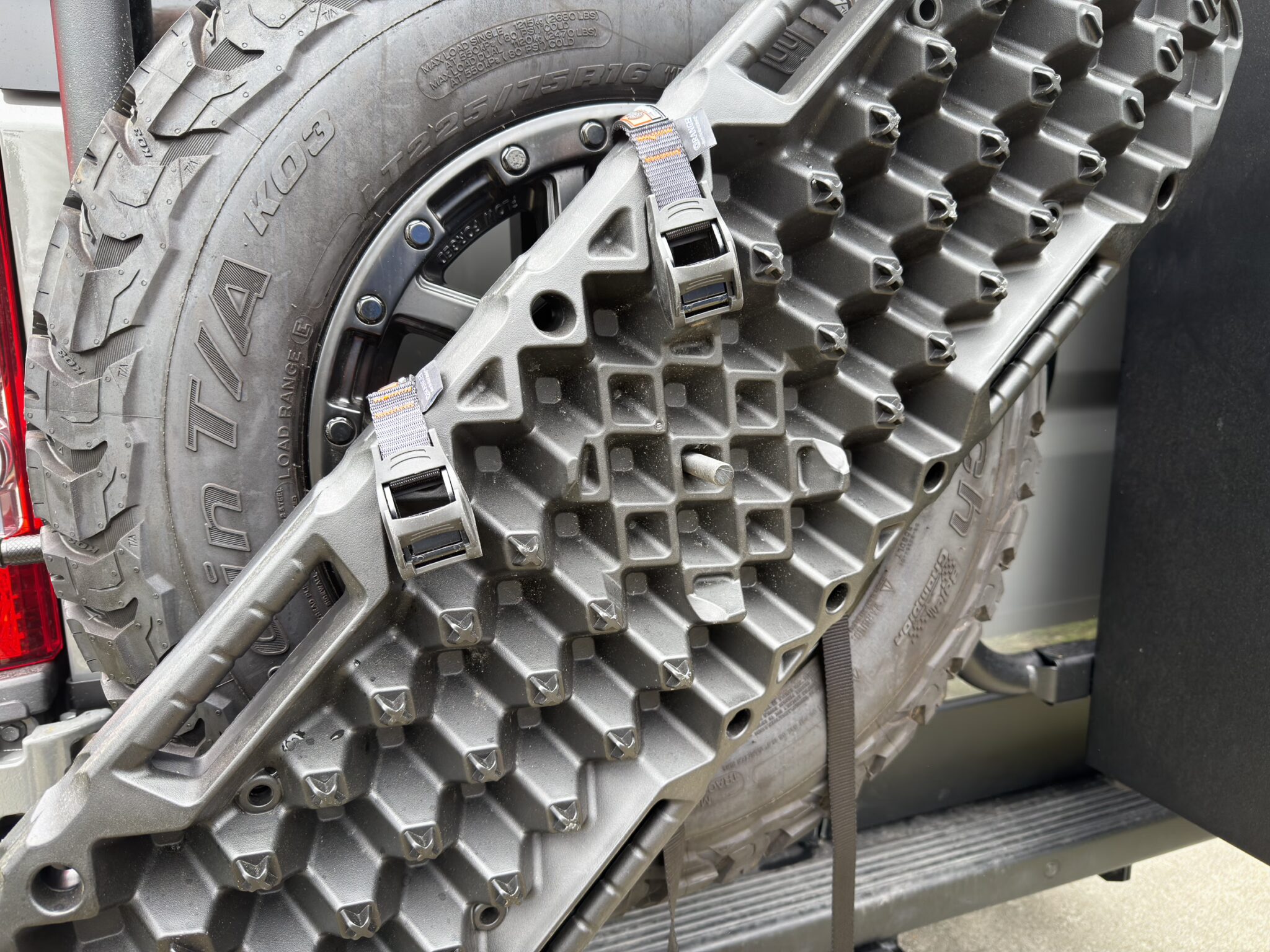
The boards need to be mounted at an angle. Mounting them vertically blocks your license plate’s visibility. Mounting horizontally will put the bottom of the board out into path of the airflow around the van. With the bunker boards, the existing Rover tightener will fit neatly into the backside of the board.
Step 2: Attach straps (one-time step)
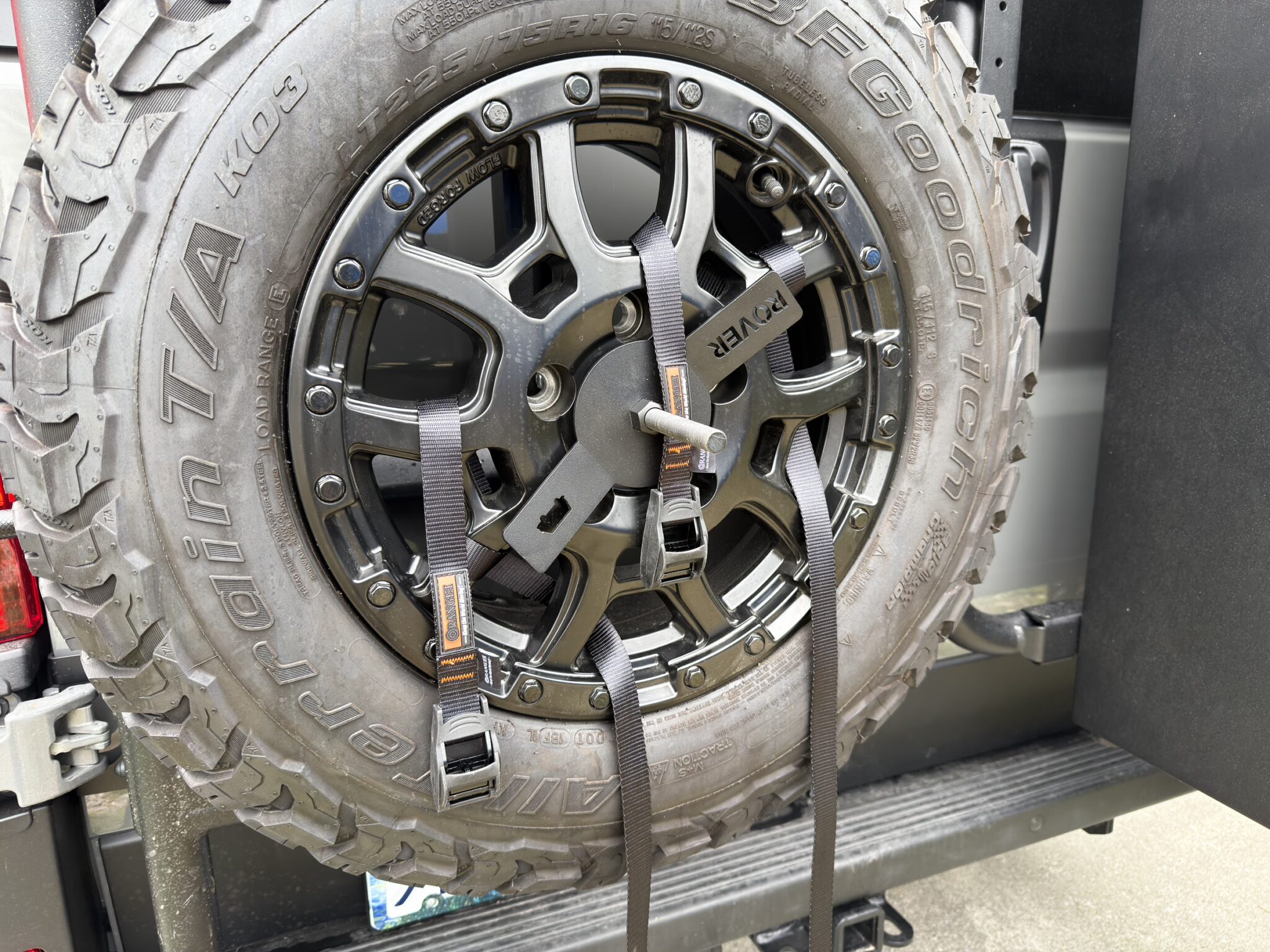
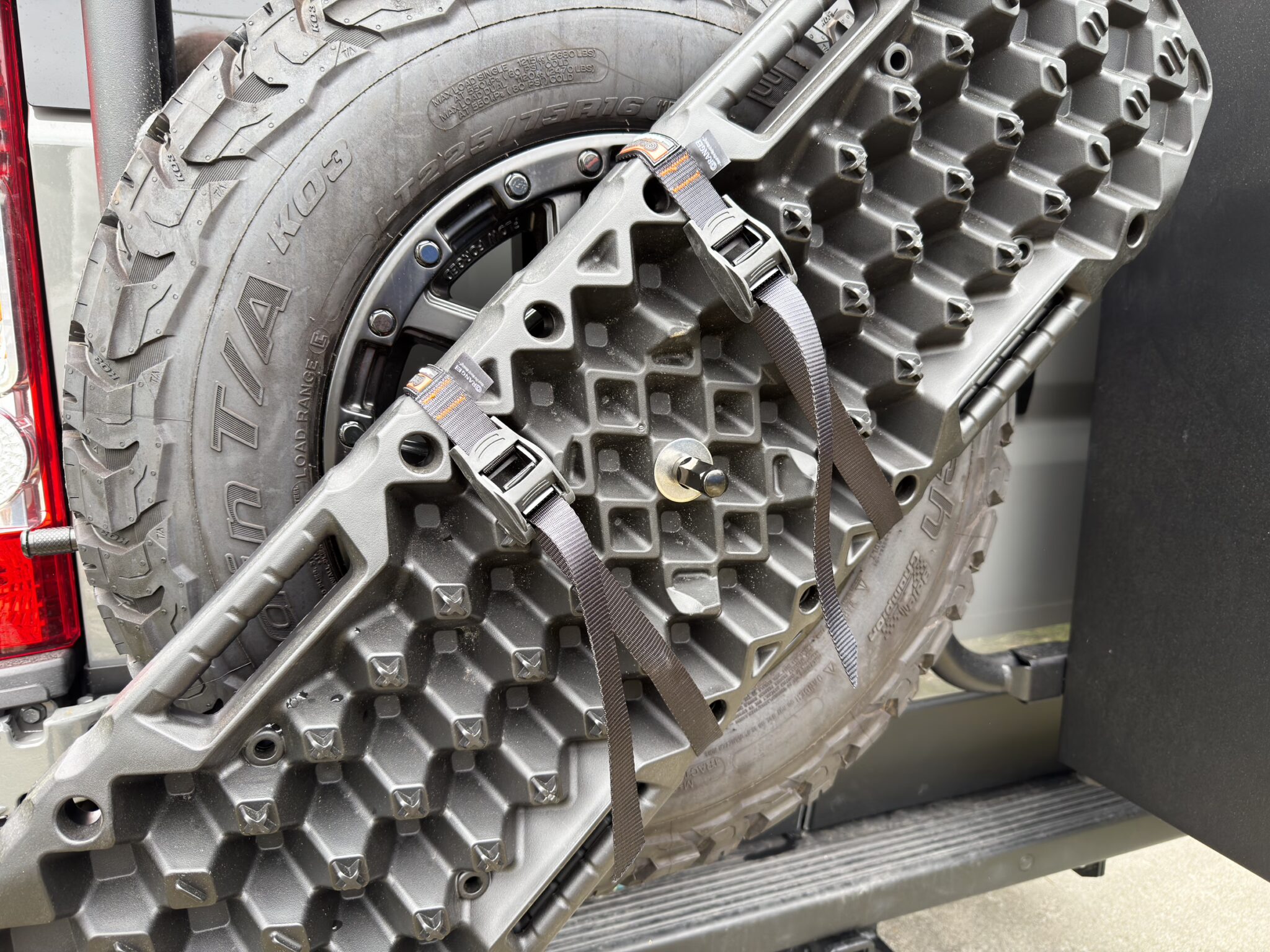
You’ll want to attach each of the two straps to the rim of the tire as shown, spanning three spokes of the wheel, with the strap looped around the central spoke. This looping prevents the straps from falling out when loosened. Why do you need straps at all? To prevent the boards from rotating on the screw. At least one strap is mandatory. I use two. With the Noovo rims, the edges where the strap touches are not sharp. If you have different wheels check yours.
Step 3: Drill holes in boards (one-time step)
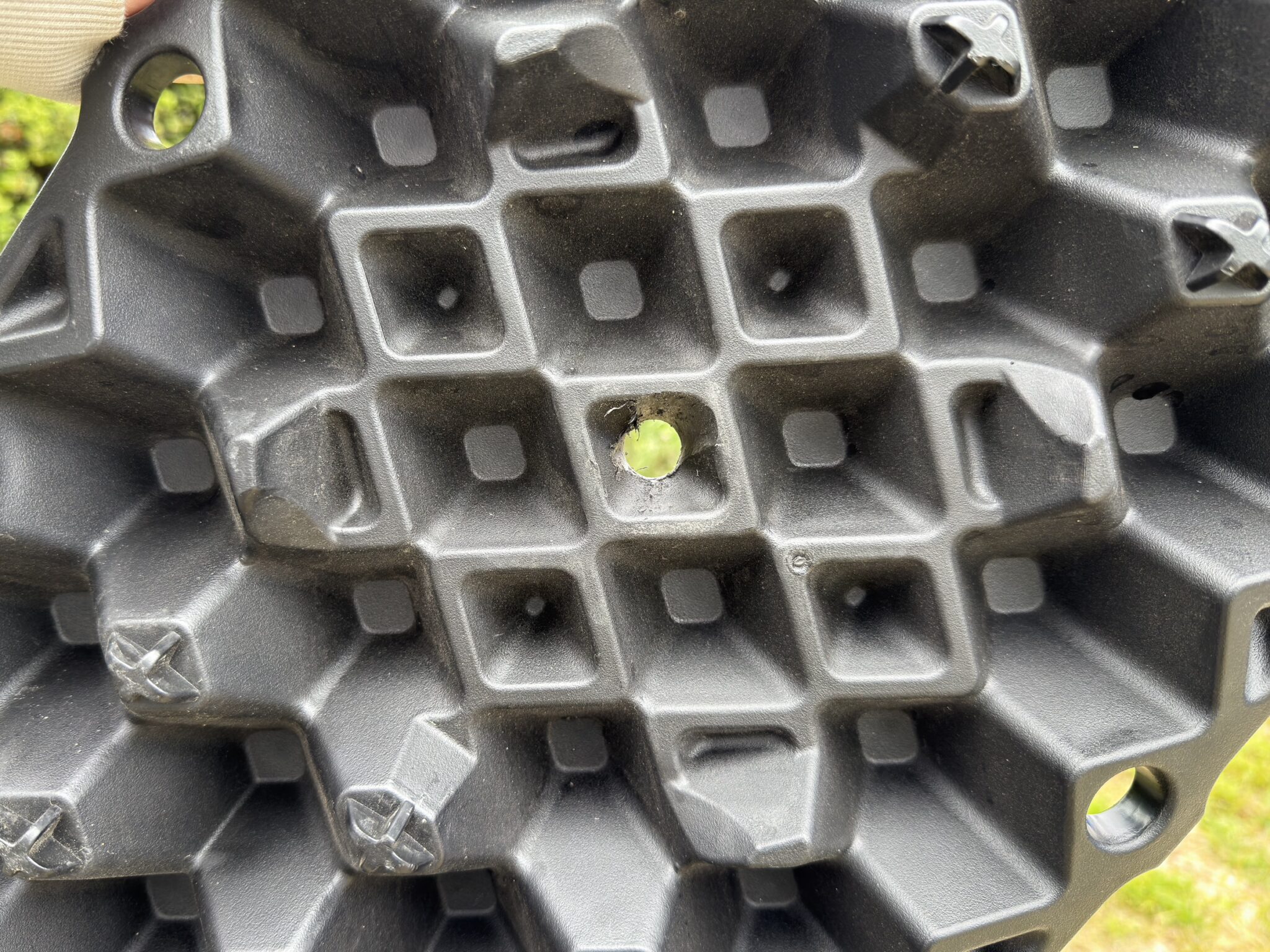
The Bunker design has an easily found central point. You’ll need a hole big enough to fit around the 14mm bolt. Examine the edges of your hole after you drill and smooth out any jagged edges with a sharp knife—you don’t want to encourage cracks to form.
Step 4: Mount boards over long screw
They will fit easily and will fall into place over the Rover tightener.
Step 5: Tighten the boards to the wheel with the washer and lug nut
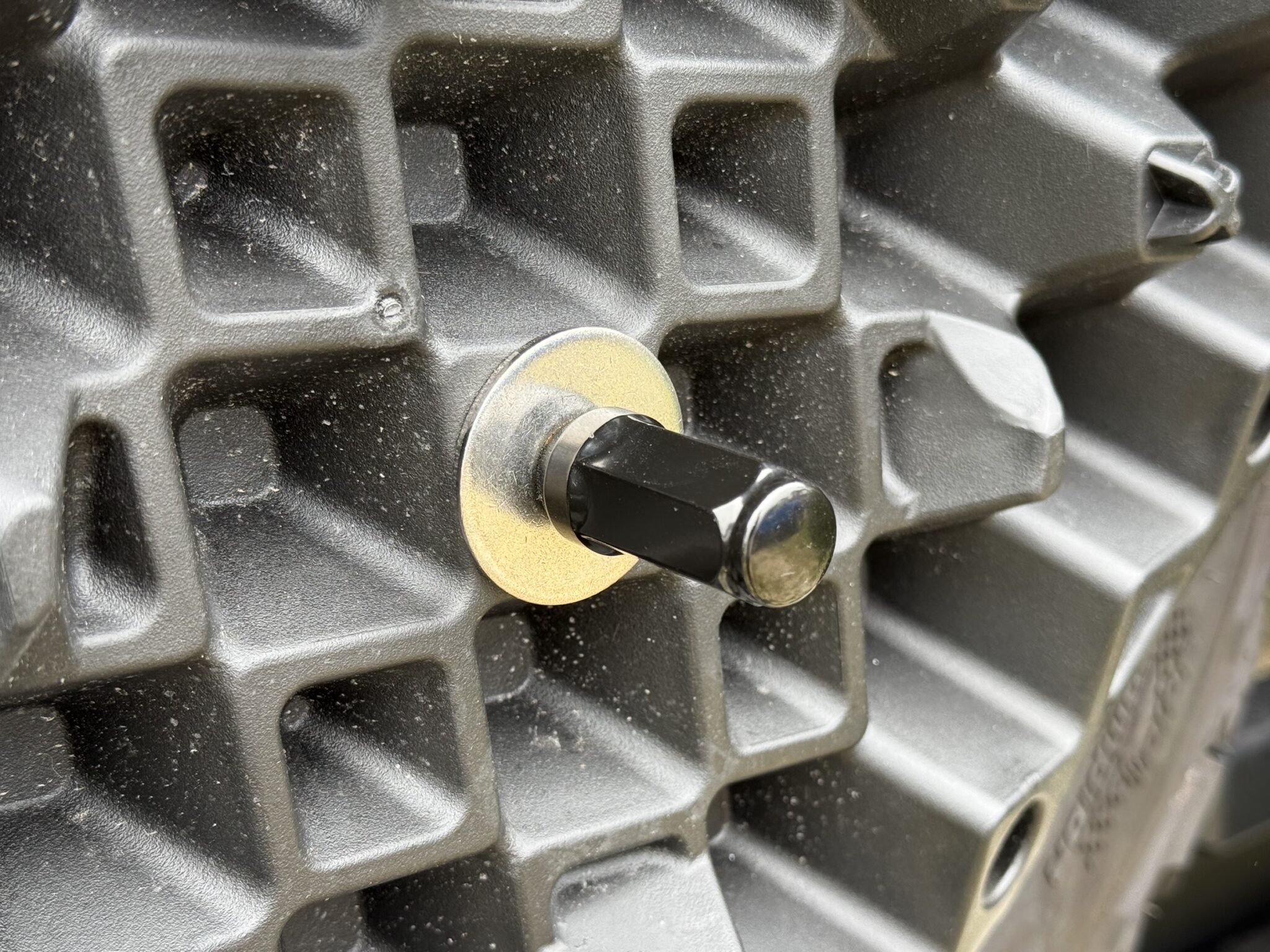
Place the stainless steel washer over the screw and tighten down the lug nut. Do not use a tool to tighten the lug nut unless you plan to use a tool to get it off later on. Hand tightening should be fine, and will press against the washer, keeping everything nice and snug. Note that the lug nut, in addition to securing the boards, will also protect the screw’s threads and, at the same time, will keep its point from snagging clothing and skin—solving another problem.
Step 6: Tighten straps
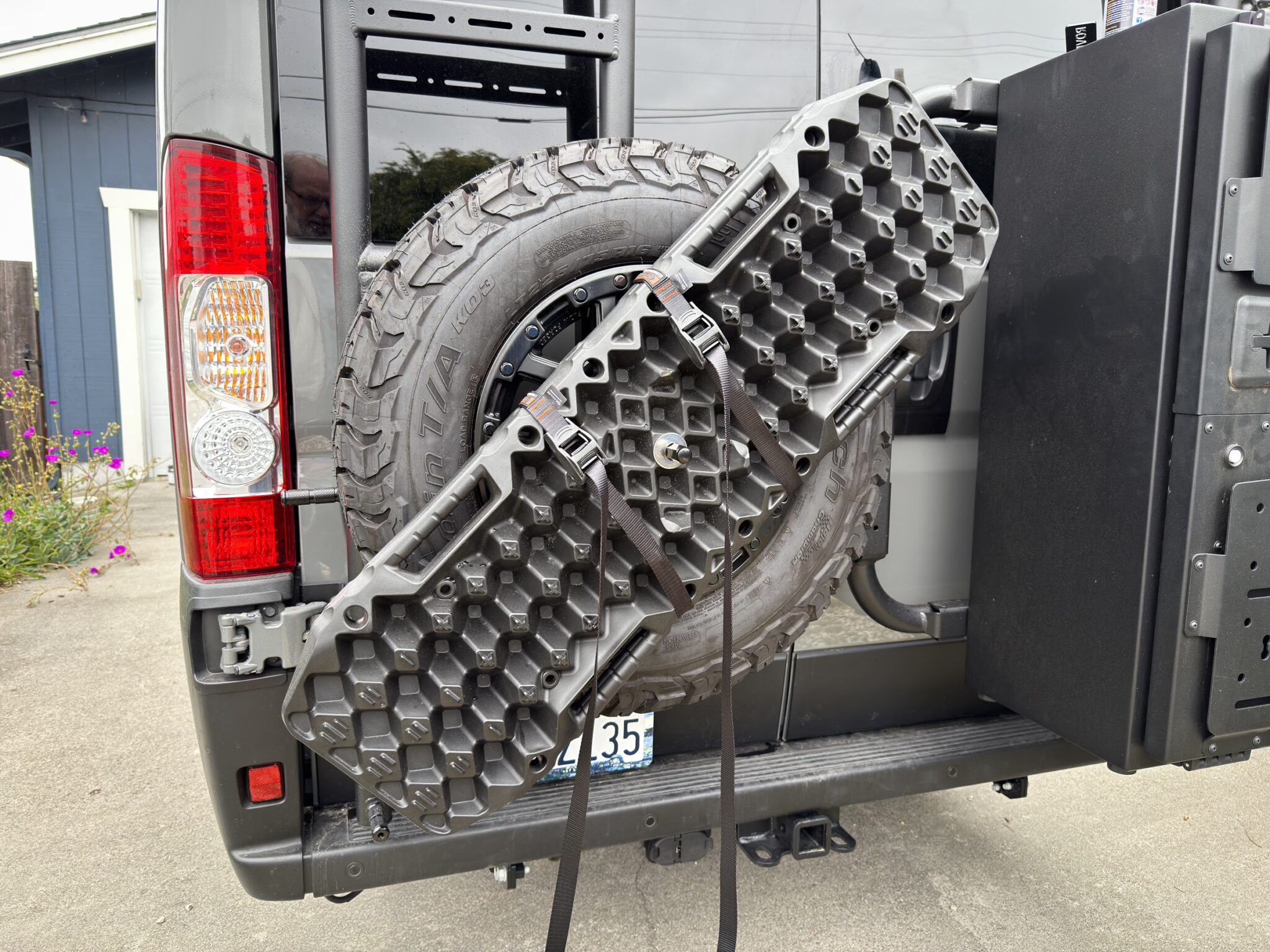
Tighten the straps, keeping the clasp toward the edge of the board. You’ll want to minimize the travel of the heavy clasp when you remove the board so that it doesn’t have enough momentum to swing down with force and dent or scratch your van. This is also why, if you use different straps than the ones I recommend, the clasp or ratchet should be plastic or rubber-covered.
Step 7: Trim the straps to the proper length (one-time step)
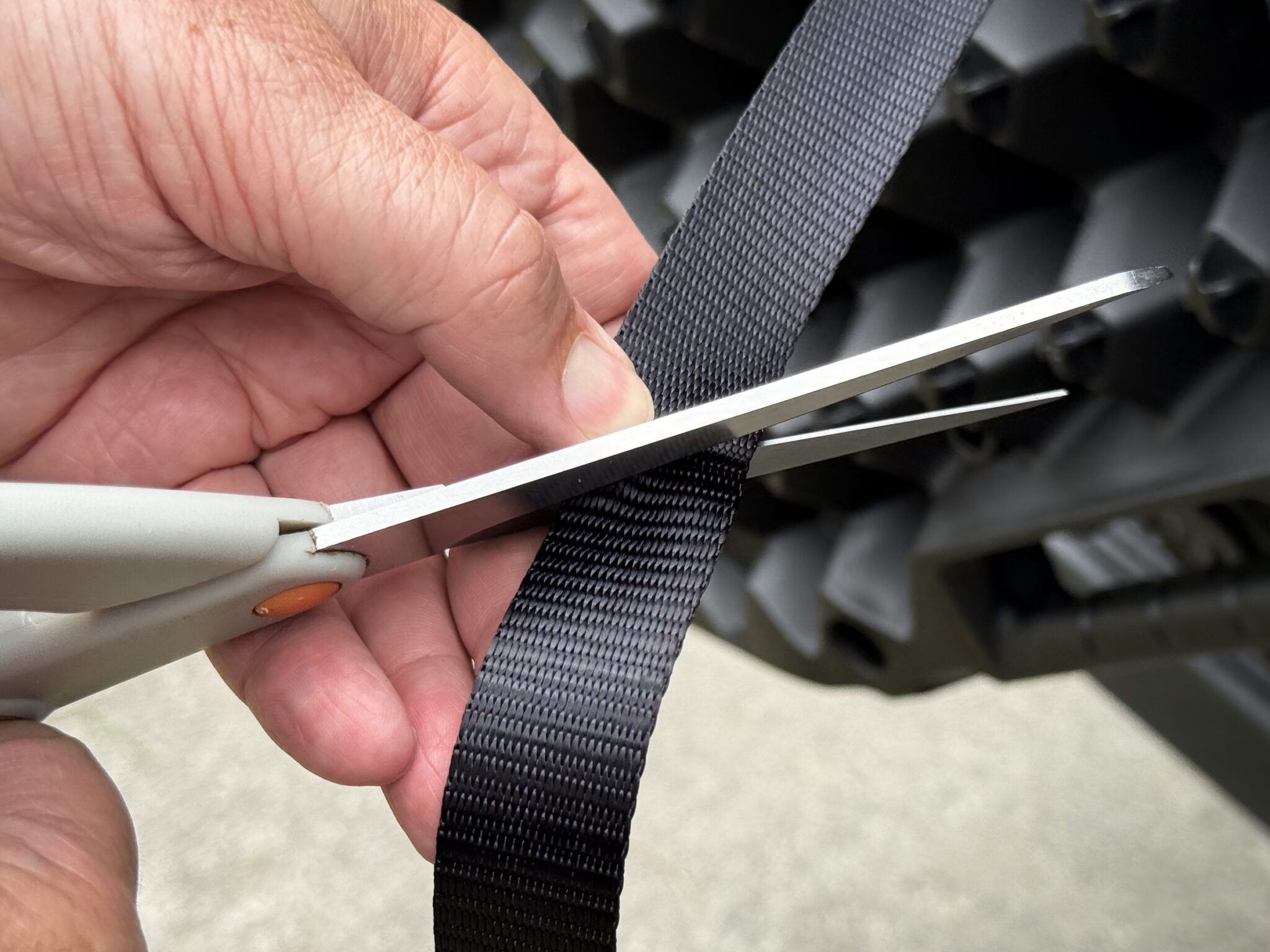
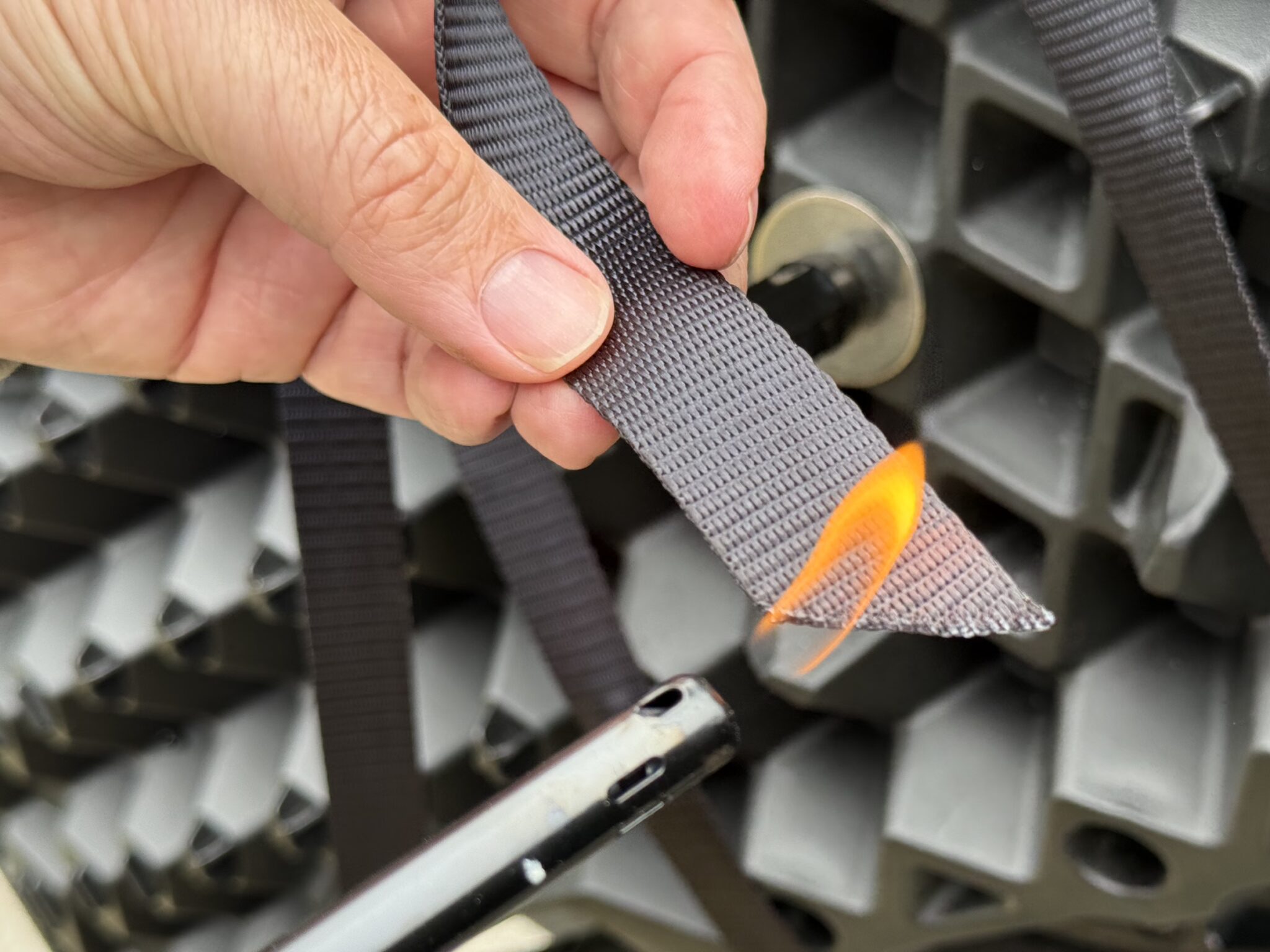
Measure a length of strap beyond the clasp (I used the length of a large pair of scissors to determine the length) and trim the strap diagonally. The diagonal cut will allow the clasp to be more easily threaded. You will need to “flame” the edges to melt the nylon a bit so that the strap doesn’t start to come apart at the edge.
And that’s it, simple, effective, and secure. It’s good-looking, too, with the rear of the van seemingly taking its design cues from the paintings of László Moholy-Nagy.

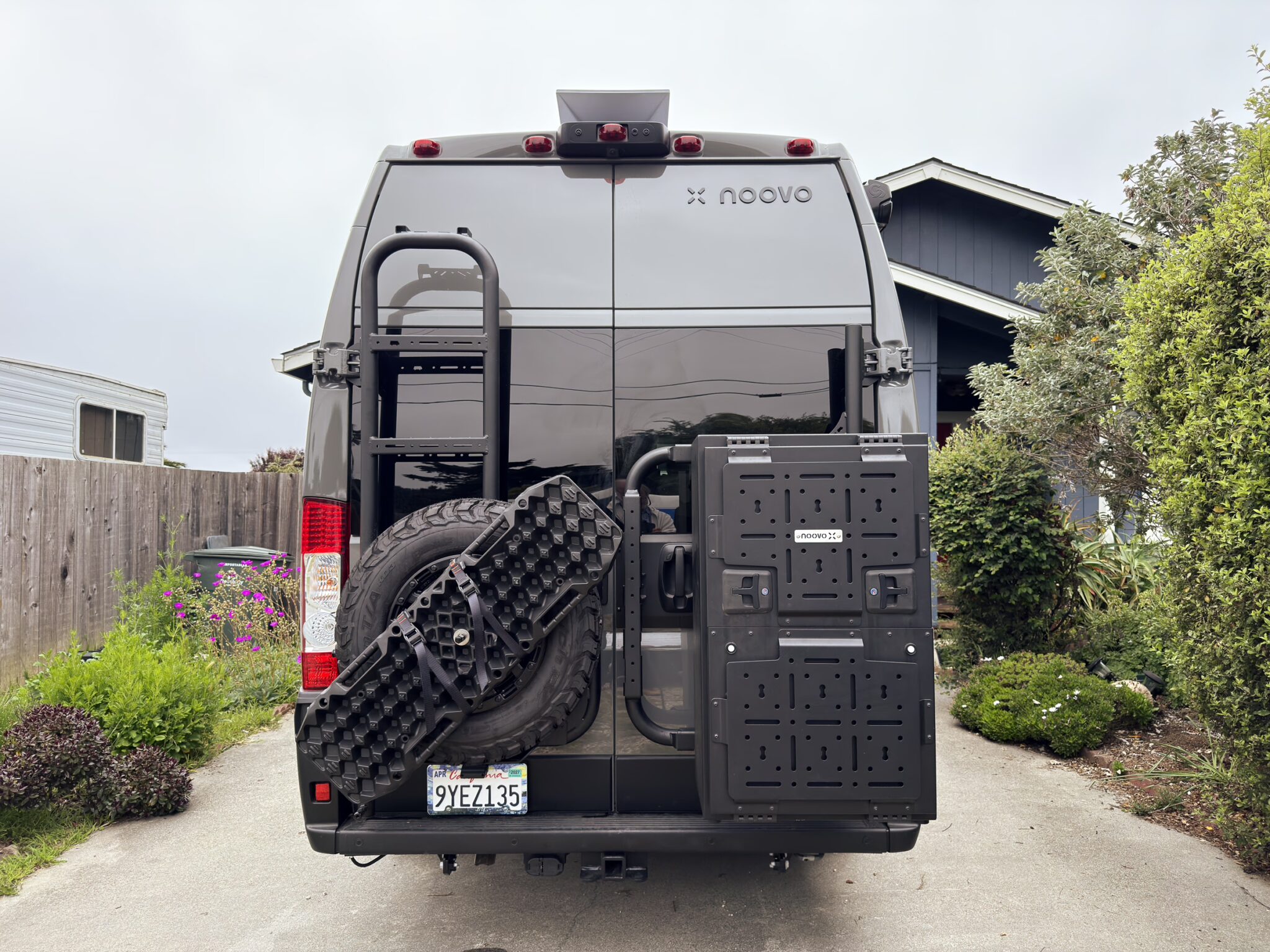
It takes me less than thirty seconds to unmount the boards. The total cost, if you buy the single lug nut, is $38, not counting whatever traction boards you use, which also gives you two extra straps to use for another purpose.