

Conrad Hilton, the hotel magnate, is talking with Don Draper, in season 3, episode 9 of Mad Men. It’s the middle of the night, Draper, dragged out of bed by a call from Hilton, sternly inviting Don to visit him at his room for a drink. There, Hilton, one of the leaders of the travel industry, unburdens his soul, just a bit, talking of his mission not so much in terms of hotels but in terms of using travel as a means to export American values abroad. America, having God, is a force for good against atheistic, communist countries, he says. Distilling the essence of travel as a political force, and revealing his own source of motivation, he tells Draper “Everyone who saw our ways,” during the European reconstruction of the Marshall Plan, “wanted to be us.”
Make what you will of Hilton’s political point of view but he is certainly right about one thing: Travel is more than travel. Travel is a form of politics, a form of exposing yourself to others and them to you, of promulgating one’s values and testing them as well. Travel may change you, travel should change you. It is often unrecognized that that same travel holds the potential to change others as well.
Things that are foreign (foreign places, foreign people, foreign food, foreign cultures, foreign ideas) are the basis of travel. Travelers seek the unknown, the unfamiliar, the new, even if the travel is to a well-worn family getaway. Foreign people can be especially intriguing, so like ourselves but in some fundamental, inarticulable way, so very different.
Even people who, at first glance, may seem to be just like us can be, in their way, foreign. Rick Steves is a travel guru, devout evangelical Lutheran, and a vocal proponent of legalizing marijuana, a follower of progressive politics without the expected anti-Americanism. He comes off, to me, as a sort of late-1970s, post-hippie dude, with the standard middle-of-the-country Christian haircut (despite being born in Barstow, California, and living almost all of his life near Seattle, Washington), and something of a puzzle. He is, in important ways, foreign to me.
His overall philosophy is sort of the inverse of that of Conrad Hilton. Steves sees Americans as too parochial, too unaware of what is going on in other countries, too inward-looking, and given the power the United States wields in the world, he thinks that, perhaps, Americans should learn more about the world and its peoples. Travel is again the answer.
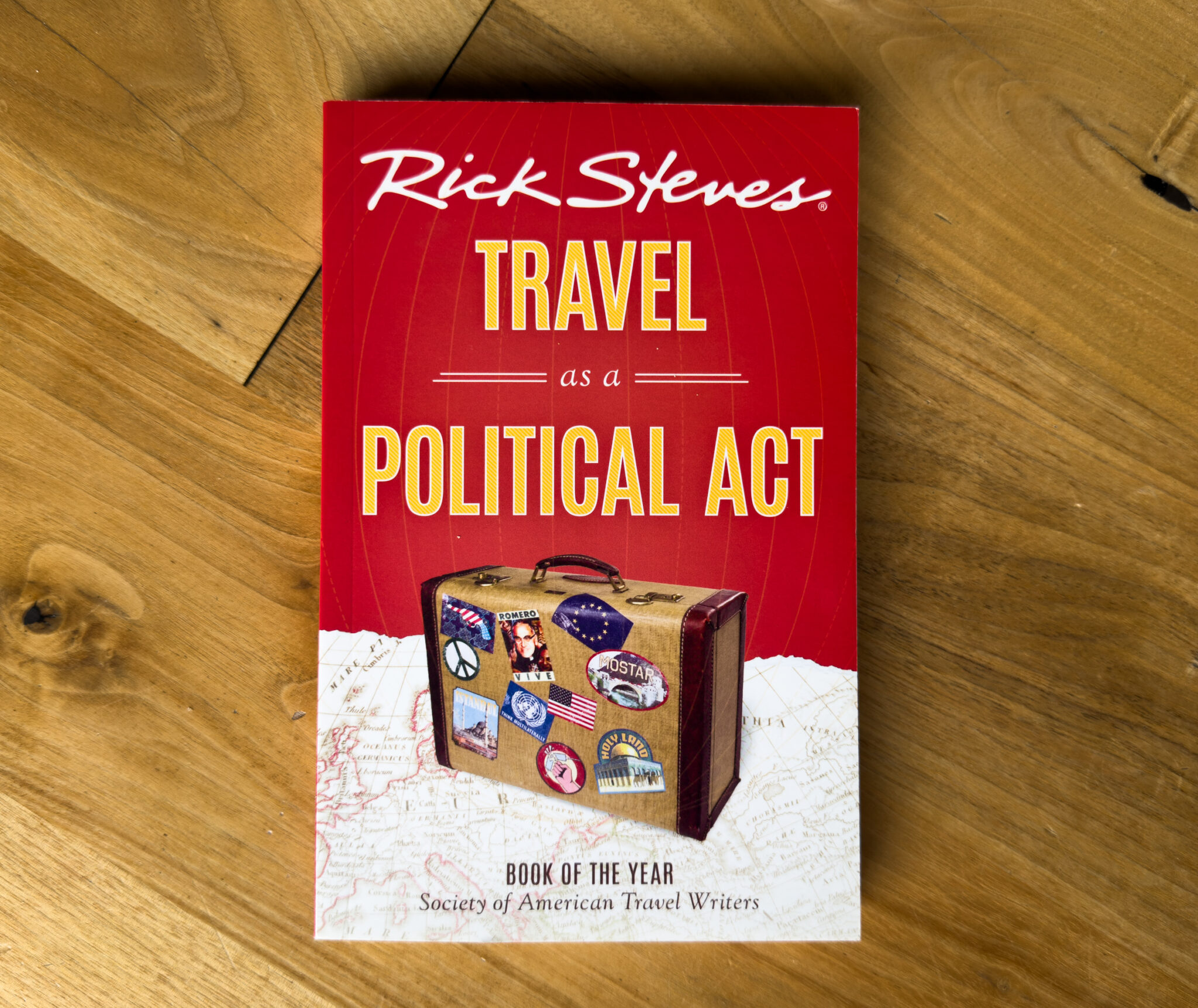
To make his philosophy more explicit, Steves, back in 2015, published a book: Travel as a Political Act, which uses Steve’s own travels to flesh out his own political growth.
Given his expertise and the focus of his travel company on Europe, you might think he’d start off in Paris or London, Rome or Berlin. But no. The first chapter is about recovery and endurance after a terrible war in the former Yugoslavia. Then indeed he takes us to our expected Europe, but unexpectedly focusing not on the Louvre, Big Ben, the Colosseum, or the Brandenburg Gate, but upon the struggles and opportunities of unification, the great continental experiment in meta-democracy. Perhaps surprisingly, we leave Europe altogether and next consider El Salvador, in between revolutions and wars and coups (a time, if chosen at random, that would be sort of like hitting a bullseye in darts, blindfolded) and then, from chaos to its opposite, we are in Denmark. Islam is not forgotten here, represented by Morocco and Turkey (Türkiye), and then, after a detour into the question of legalizing pot, we find ourselves, like Steves himself, immersed in Iran and then the Israeli-Palestinian issues. I remind you that this book was published over a decade ago.
With each destination Steves is trying to experience the country as it actually is, not some tourist simulacrum, asking questions about its culture, its history, looking and trying hard to see while looking, trying to refrain from imposing his own beliefs upon his experience until he has at least attempted to understand what he is seeing and hearing.
It’s an incredibly noble effort and an extraordinary model to follow, even if you disagree with the insights that Steves takes home after each trip. The very idea of traveling not through a country but within it, taking each destination as an opportunity not to relax and rest from your day job, but as a window to step through into another world, sometimes the same as your own, sometimes so very different, and to try to make some sense of this other world.
Steves’ focus is all about international travel, of course, but the same ideas, unchanged, can be brought to bear on road travel within North America, within the United States. Each state, each region, has its own history that has shaped the culture within, each place has its own politics and its own challenges, its own opportunities for a visitor, camping in a van, to have a better idea of the place they are at, a place more than National Parks, Cracker Barrels, and dispersed camping sites (and even there, there is more to understand with each of these).
Travel is a way to see things, yes, to experience places and people in a way that can be impossible to experience in any other way, but also a way to experience yourself, to raise your awareness of our divided country, where a citizen from Alabama, visiting California, can seem more foreign there than an Iranian tourist, where a enjoyable, spontaneous conversation in Nebraska can become formal and carefully polite by the discovery that you are from California.
As we become more convinced, as we stare like cows into our screens, that we know all about those other people in those other states, and that they are bent on bringing communism to our land, or that they are all racists, or that, good god, they are dumb as rocks and maybe evil, too, travel can be just the thing to change the country and to change ourselves. Conrad Hilton and Rick Steves both would be proud.