

Most of the salsas sold in grocery stores are sort of bad. For a preservative, they use far more vinegar than you would normally put in a salsa, and it often ends up being the dominant taste. That’s not salsa… fresh salsa is salsa!
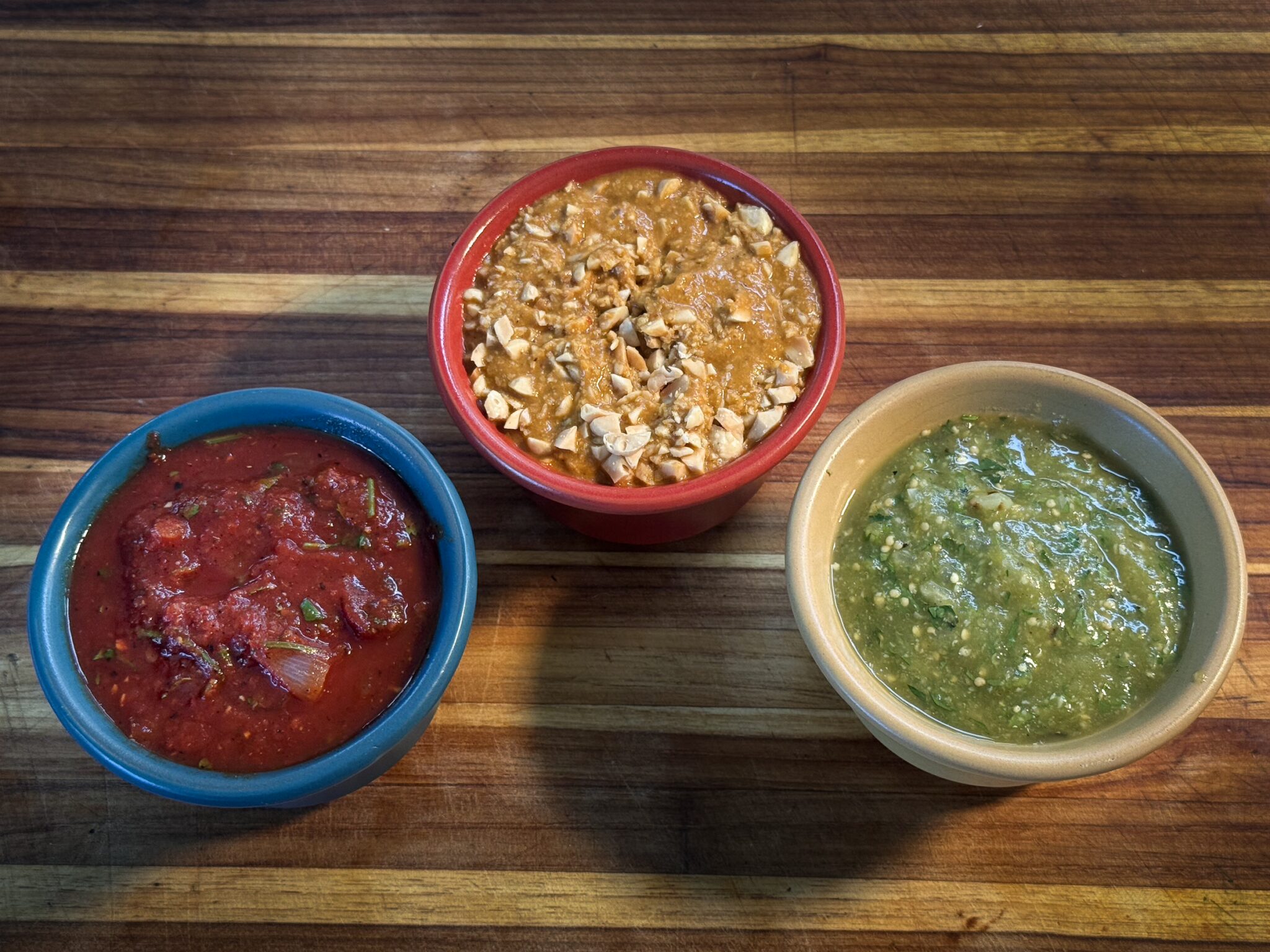
Can you make fresh salsa in a van? Well, of course! Here are three recipes that can be made while on the road. With small changes, they can be repurposed as sauces or condiments. Let’s make salsa!
First, a few notes
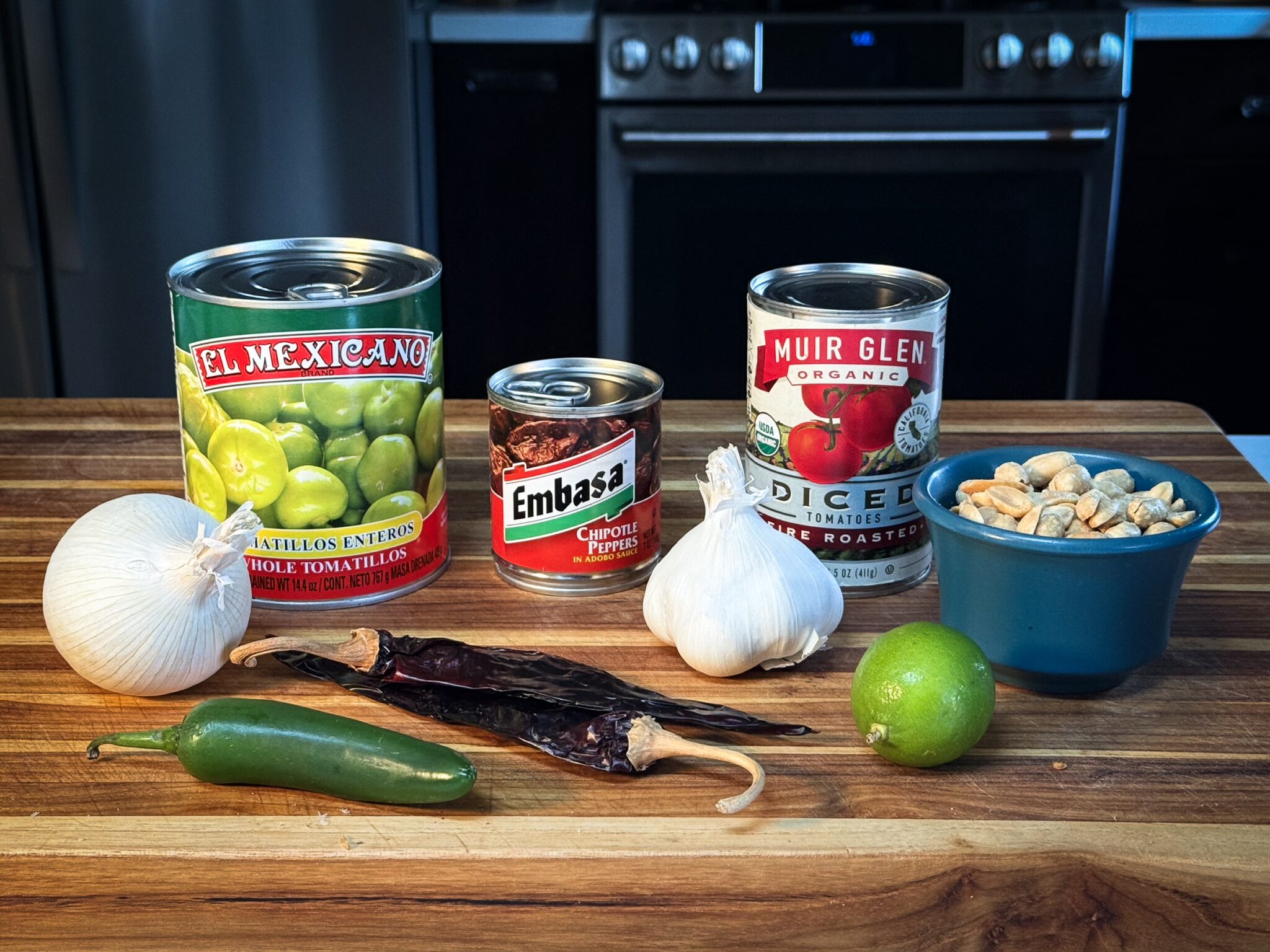
To reformulate these recipes for making in a van, I’ve substituted canned chipotles and canned tomatillos for fresh. The canned chipotles are very good, and the canned tomatillos are surprisingly good, though fresh is still better and not very much more difficult to use.
Also, as these recipes are written, they will have a heat level that I would call “barely noticeable,” but what others might consider “Oh my god, my mouth is on fire!.” When making salsa for a group, it is usually better to aim at a lower heat and then just add hot sauce to your own for a more full-flavored experience.
Another word on salsa heat: A given salsa will taste hotter when tasted on a spoon, less hot when tasted on a tortilla chip, and even less hot when eaten with food. This is the key to getting the heat right for any occasion: Make it a little spicer than your target heat level.
Let’s make salsa!
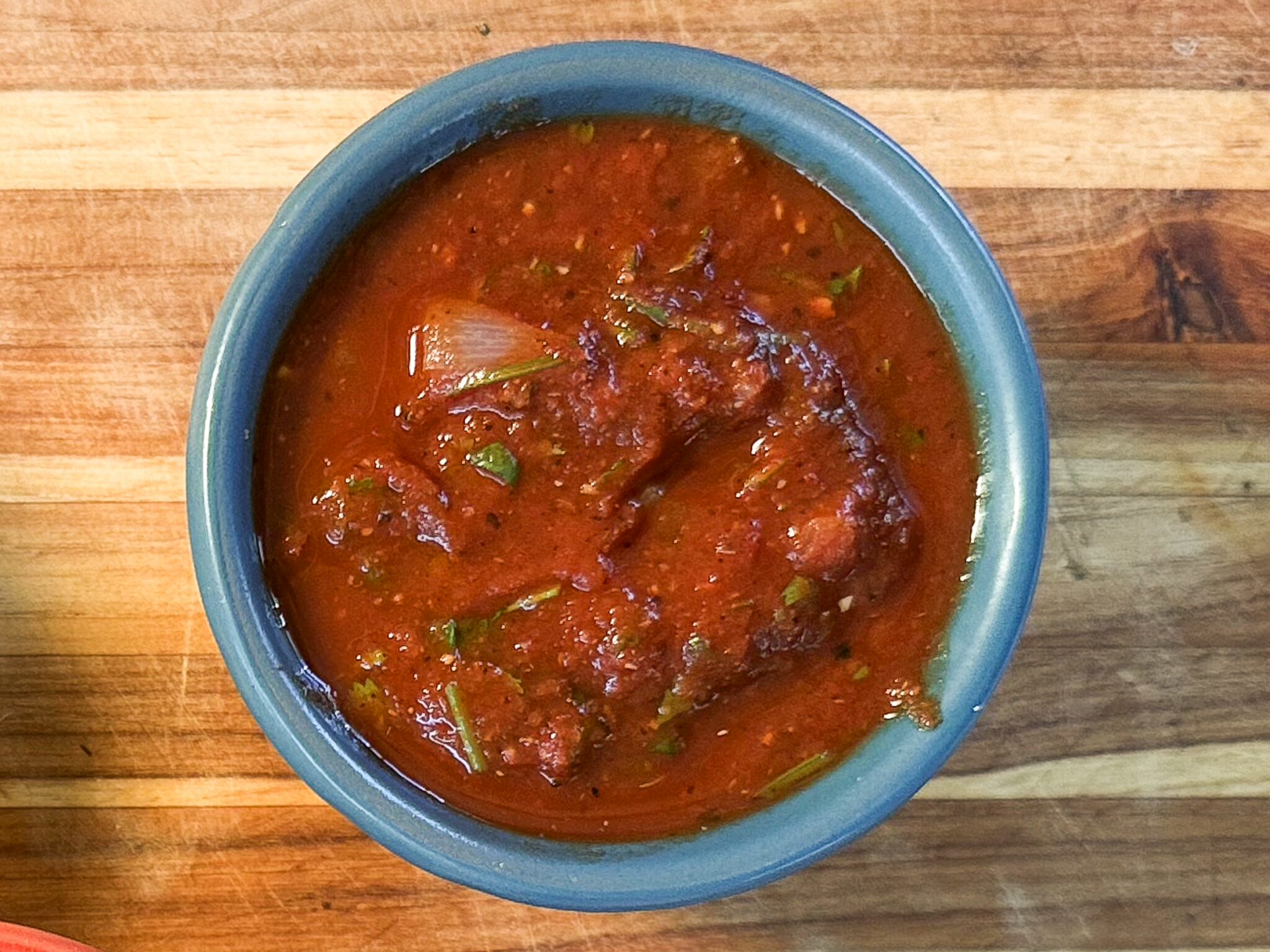
Fire-roasted Tomato Salsa
Equipment
Induction cooktop, cooking pan, a source of hot/boiling water, and a blender (I use the Ninja Blast, which works great.)
Ingredients
3 guajillo peppers
2 arbol peppers (optional, but not really)
1 15 oz. can of fire-roasted tomato sauce
White onion (about half a small onion), cut into thick slabs
4 garlic cloves with their papery skin still on.
Salt to taste
Cilantro, chopped (both leaves and the stems of the leafy area)
Apple cider vinegar, lime juice, or both
Make the salsa
- Remove the stems off the 3 guajillo peppers and, using your thumb, rip open each pepper and remove the seeds and connecting tissue. These peppers are not hot, so you do not need gloves. Leave the 2 arbols whole–you will destem them after they are soaked..
- Pressing down on them now and again with a spatula to flatten them, cook the guajiilo first, then the arbol peppers in a seperate “batch” (they can burn very easily), to “wake” them, only a few seconds on each side. Be careful not to burn them. Put the peppers in a bowl and cover with hot water (the hotter the better) for at least 20 minutes, 30 is better.
- Cook onion slabs and garlic (with the garlic’s papery skins still on). You’ll want the onion soft and maybe slightly blackened, but not caramelized. The garlic will brown and blacken in spots. The goal is to soften the vegetables, not to fully cook them.
- Pour half of one can of diced fire-roasted tomato into the blender. (Blending a half can at a time helps a small blender perform better.)
- Peel softened garlic heads and cut them into two or three pieces (again, helping the small blender perform), then put the garlic in the blender. Tear the softened guajillos into smaller pieces and add to the blender. Destem the arbols and add to the blender. (Do not add the onions.) Blend until smooth.
- Add the remainder of diced fire-roasted tomatoes to the blender. If you want a salsa for dipping chips, pulse the blender briefly. If you want a smoother salsa for use as a sauce or condiment, blend until smooth. Pour into a bowl.
- Dice the cooked onion slabs and add to the salsa. Add cilantro. Add a small amount of apple cider vinegar or lime juice (or both). Add salt to taste. Stir.
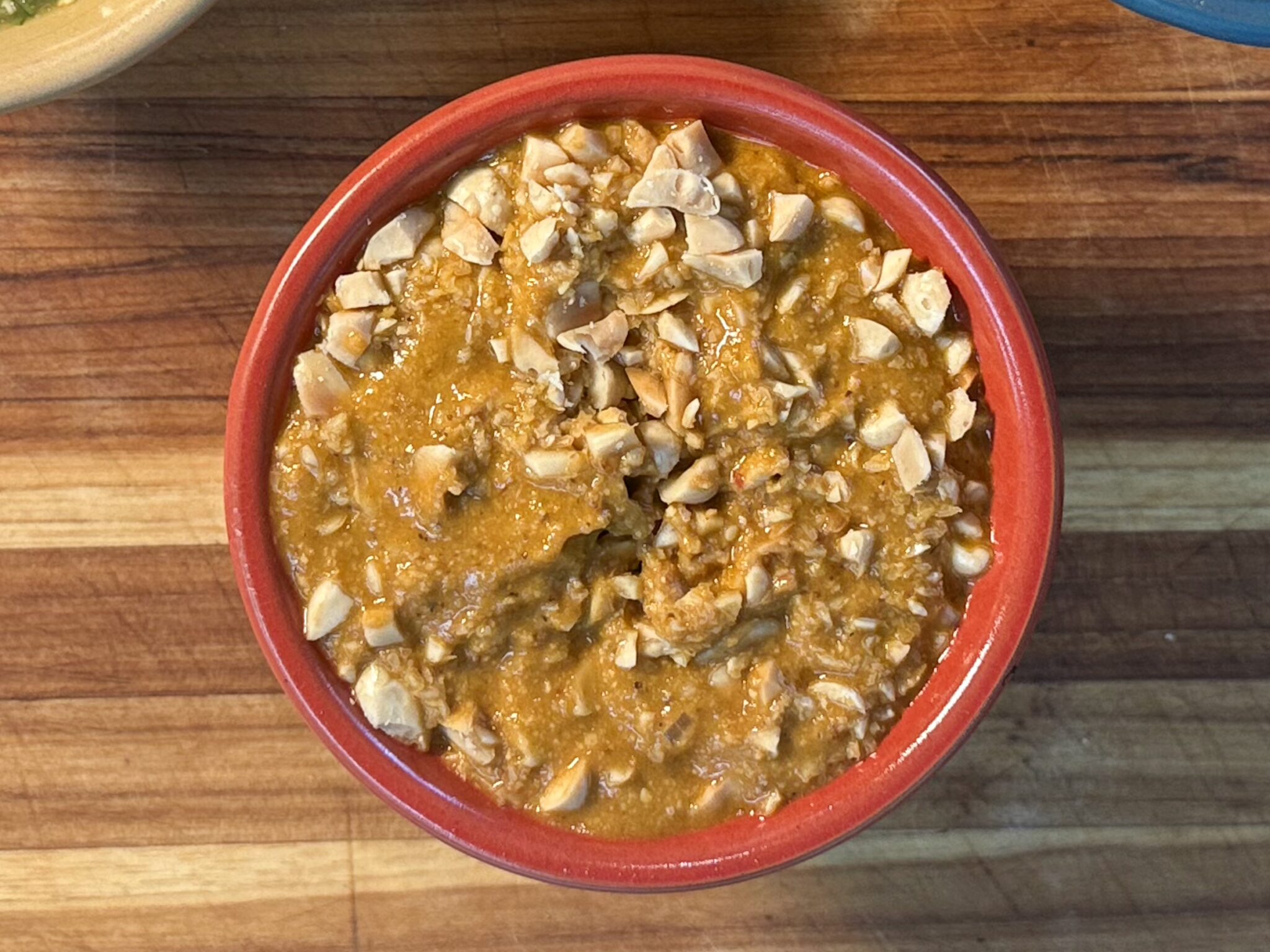
Chipotle, Peanut, and Roasted Tomatillo Salsa
Equipment
Induction cooktop, cooking pan, van-sized blender
Ingredients
3 canned chipotles (plus some of the adobe sauce they are canned in) or 3 dried chipotle moritas
Enough canned tomatillos or fresh tomatillos to fill the Blast blender about an inch shy of the Max Fill line (maybe 8 to 10, depending on their size)
4 garlic cloves with their papery skin still on
Half of a small white onion
A handful of Virginia peanuts (The Costco/Kirkland ones are great) plus chopped peanuts for garnish. Other varieties of peanuts are fine.
A dash or two of Worcestershire sauce (soy sauce for a vegetarian salsa, but not quite as good).
Cilantro, chopped
Salt to taste
Make the salsa
- If you are using dried Morita peppers (chipoltes), cook them briefly for 30 seconds or less to “wake them up,” then soak in hot water (near boiling is fine) for at least 20 minutes, longer is better, to soften them. The blender will struggle with moritas if they are not soft enough.
- If using fresh tomatillos, peel off their papery skin and cook until soft. (For larger tomatillos, you can cut them in half to make cooking faster.) Cook garlic (with papery skins still on). If using canned tomatillos, see below.
- Blend in two batches to help the small blender perform better: Batch #1: Blend half of the tomatillos, along with the peppers, until smooth. If using canned chipotles, be sure to include a tablespoon or two of the adobo sauce that they are packaged in–it is good.
- Batch #2: Put the other half of the tomatillos, garlic, and onions into the blender. Add 1/3 cup peanuts. Blend. Add a little water if the blender has difficulty because of the peanuts.
- Pour mix into bowl and add a dash of Worcestershire sauce and stir.
- Add salt to taste.
- (Optional but worth doing) Sprinkle chopped peanuts over the top of the salsa and have more ready to add, if you want, as the salsa is eaten.
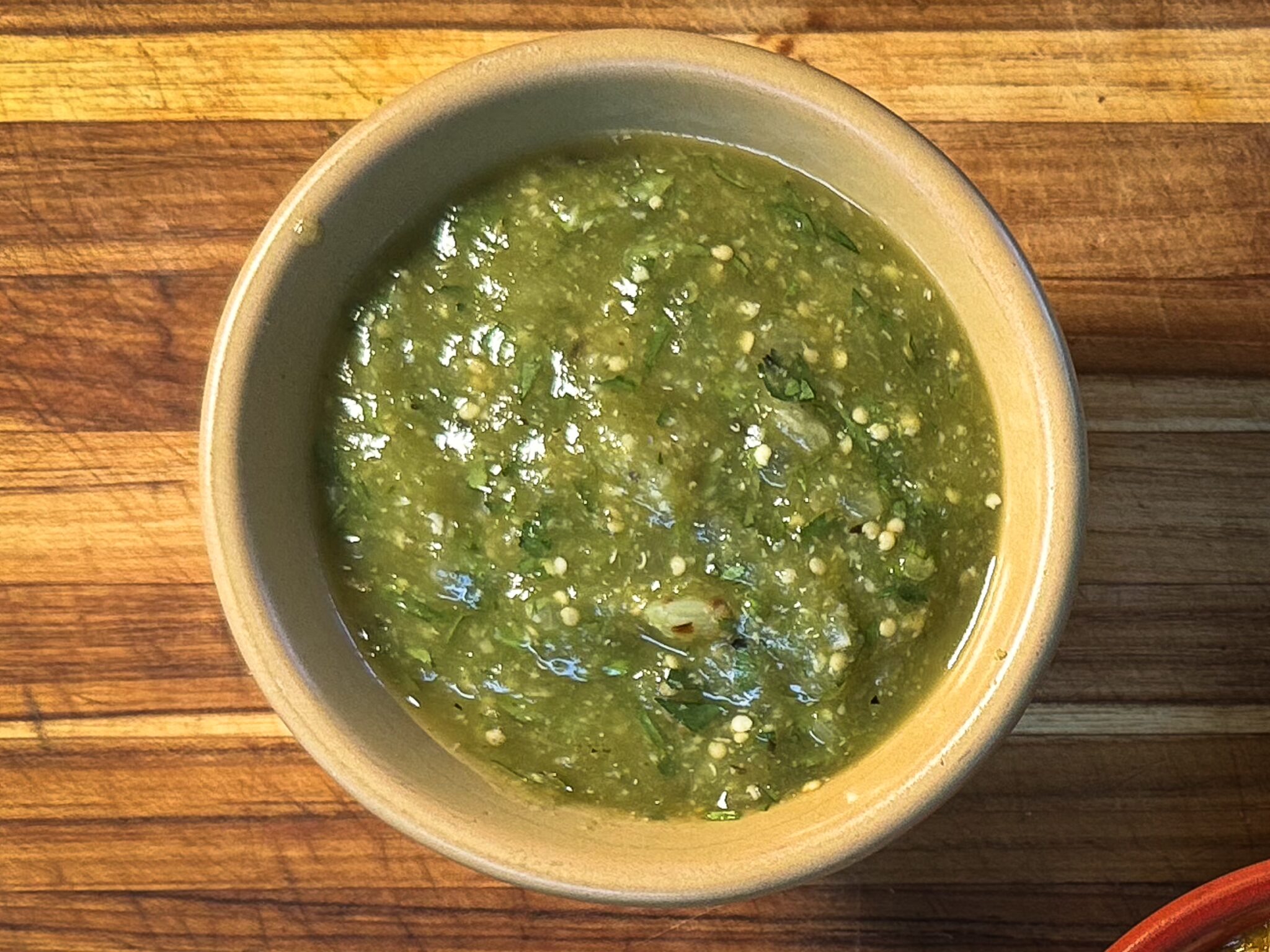
Roasted Tomatillo Salsa
Equipment
Induction cooktop, cooking pan, blender.
Ingredients
Enough fresh or canned tomatillos to reach just under the Max Fill Iine of the Ninja Blast blender
Half of a white onion
4 cloves of garlic
1 fresh serrano pepper
Salt to taste
Make the salsa
- If using fresh tomatillos, remove the papery skin of the tomatillos.
- Cook onion slabs, serrano, and unpeeled garlic on an induction cooktop until starting to brown or blacken, and tomatillos (if using fresh) until they are soft. For larger tomatillos, you can slice them in half to speed cooking.
- Destem the serrano and place in a blender, add the tomatillos and garlic, and blend until smooth. Pour into a bowl.
- Dice cooked onion and add to bowl. Chop cilantro and add to bowl.
- Stir and salt to taste.
A few more notes
If using canned tomatillos, they will already be stewed and soft, so they do not need to be re-cooked.
The vegetables can be broiled, cooked in a pan, or boiled. Broiling and pan-cooking will blacken parts of the vegetables and give the salsa a more “rustic” look, which may be desirable…or not!
Likewise, if using dried chiles, you can cook them in a pan, boil them, or even toss them in a deep fryer if you have all that oil going for some reason.
When cooking vegetables on the induction cooktop, it often helps to remove each individual vegetable as it is ready rather than waiting until everything is done. This is especially true of the tomatillos.
You can increase the heat by adding arbol peppers (easily found but which require “waking” and soaking) or a hot sauce of your choice. You can decrease the heat by reducing the number of peppers and, in the case of fresh peppers, removing both the seeds and the tissue that holds the seeds to the body of the pepper. This is where all of the heat comes from, so you might consider wearing gloves for this process. You can also reduce heat by using jalapeños instead of serranos, though be warned that “improvements” in the jalapeños that you see at grocery stores make them large but inconsistent in heat. Most will be at the lower end of the heat scale, but one in ten or so have significantly more heat.
A reminder: To judge the correct amount of heat, consider this general rule. A salsa will taste at a given heat level when tasted in isolation with a spoon. That same salsa will seem less hot when tasted on a tortilla chip. That same salsa tastes even less hot when eaten with food. Thus, you have to aim for a heat level higher than your desired heat level when making salsas.
Unlike peppers in other cuisines, Mexican peppers generally add flavor as well as heat. The choice of paper can dramatically affect the taste of a salsa. The arbol pepper is the exception to this, which, in most salsas, adds (a lot of) heat without much additional flavor.
Guajillo and arbol dried peppers are easy to find nationwide. (And, being dried, they are small and somewhat non-perishable if you want to stock up). When soaked, they become soft quite readily—unlike the moritas, which take longer to soften. The blender will have no problem with softened guajillos and arbols.
In all salsas, the overarching goal is not so much heat, or even any specific flavor, but balance. Taste as you go along and modify the recipes as you see fit.
These recipes are, more or less, van-oriented adaptations of the recipes from Rick Bayless’s site–fantasic stuff, check it out. Also see his YouTube channel.